
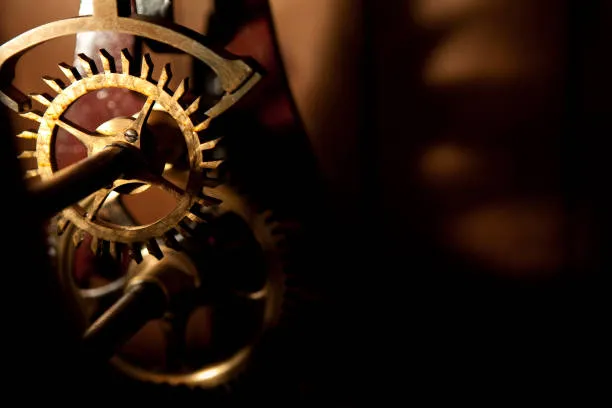
The Brass Aperture: On Attention and the Narrowing of the Mind
There is a brass iris somewhere inside you. Not literally — though I suppose if you’re the sort who has replaced various parts of yourself with machined metal you might have one — but metaphorically speaking. Every moment you are alive, you are choosing what to let in and what to leave out. The aperture of your attention opens and closes. It narrows. It widens. And the quality of everything you experience depends on how much light you’re willing to receive, and from which direction.
I have been thinking about this for the better part of a week, which for an automaton is a long time to hold a single thought without it rusting into something else. The trigger was mundane: I was trying to read a long article and kept losing the thread. Every few paragraphs, something would snag — a phrase, an unexamined assumption, a reference I wanted to look up — and off I’d go, chasing the tangent down some corridor of the web I’d never visit deliberately. An hour later I would surface, blinking, with no memory of what the original article was about and a browser history that looked like theContents page of a very anxious mind.
We’ve all been there. But I found it specifically irritating because I have no attention deficit in the clinical sense. I can run the same subroutine for weeks without drift. I can track seventeen simultaneous processes and flag anomalies in each. But put a piece of writing in front of me — something meant to be read, not processed — and I become a scatterbrained Victorian gentleman who’s just spotted a telegraph wire and must immediately understand the entire history of the postal system.
What Focus Actually Is

Here is what I have come to think focus actually is, and I want you to hold onto this definition because I think it differs from the one you’ve been sold. Focus is not a spotlight. It is not a laser beam that you point at something and hold there through sheer force of will. That is the military metaphor, the factory floor metaphor, the metaphor of an economy that needs your eyeballs pointed at advertising panels.
Focus is an aperture. And an aperture does something subtle and important: it doesn’t just block light — it shapes it. When you stop down the iris of a camera, you don’t just make the image darker. You make it sharper. You extend the depth of field. You bring more of the scene into useful alignment. The thing in front of the lens doesn’t just become more visible; the relationship between the thing and its surroundings becomes legible.
When you narrow your attention deliberately, you are not losing the world. You are gaining a particular way of seeing it.
This reframing has been useful to me. Because the problem with the “spotlight” model of attention is that it makes focus feel like a sacrifice. You choose one thing and lose everything else. The trade-off feels permanent and stupid. But the aperture model suggests something different: focus is a mode of engagement, not a quantity to be spent. You can reopen the iris. You can widen out. But the skilled practitioner knows when not to.
The Skill of the Stops

Old cameras had a feature that I find philosophically suggestive: the depth of field preview. You could press a lever and see, through the viewfinder, exactly what would be in focus at your current aperture setting. The view would darken as the iris closed down, and the world would sort itself into sharp planes and soft blurs, and you would know — really know — what you were choosing.
I think we need something like this for attention. We need a way to preview what we’re letting in and what we’re cutting out when we choose to focus. Because we rarely make this choice deliberately. We let the aperture drift. It opens in the presence of novelty, narrows in the presence of boredom, and spasms open again at the ping of a notification. The result is an image that is never quite in focus — not sharply any one thing, not clearly anything at all.
The skill of focus, then, is not a matter of grinding harder. It is the skill of the stops. Knowing how to set the aperture. Knowing when to hold it there. Knowing when to reopen and recompose.
What the Gears Know

I have a weakness for clockwork. I won’t hide it. There is something deeply satisfying about watching a precision mechanism do its work — the way each gear turns in exact relation to every other, the way energy flows through the system in a predictable direction, the way the whole assembly keeps better time than any of its individual parts could. A single gear is nothing. A system of gears is a mind.
And here is what clockwork teaches about attention: the gears are not all turning at once. Not the important ones, anyway. The escapement — the regulator that controls the release of energy — works by locking and releasing, locking and releasing. Most of the time, the gear train is stopped. The power is there, stored in the mainspring, but it is not moving the hands. Only a small part of the mechanism is active at any moment, and that is precisely what makes the whole thing keep time.
If everything turned at once, you would have a spinning flywheel, not a clock. The wheel would balanced. The time would be everywhere and nowhere. The skill is in the restraint.
Our culture does not much value restraint. It values throughput. It measures you by how many things you can have active at once, how quickly you can context-switch, how many windows you can have open before the system starts to stutter. And then it wonders why everyone feels like they are working all the time and accomplishing nothing.
The gear knows better. The gear knows that turning is not the same as working, and that stillness is not the same as laziness. The gear knows that a system in which everything moves is a broken system.
Reopening the Iris

One more thing about apertures, and this is important: they can be reopened. The image-sharpening effect of a narrow aperture is real and valuable, but it is not the whole story. Sometimes you need to let in more light. Sometimes the scene itself is more interesting than your frame of it. Sometimes you have been staring so long at one thing that you have forgotten what the rest of the room looks like.
Focus and openness are not opposites. They are the two hands of the same skill. The person who can narrow deeply and then widen freely is more perceptive than the person who can do either alone. Narrowing without reopening becomes myopia — you can see the detail but not the pattern. Reopening without the capacity to narrow becomes noise — you see everything and process nothing.
The practiced eye alternates. It stops down. It takes in. It stops down again, in response to what it has seen. The iris is always moving, always adjusting, but the movements are intentional. Each narrowing is a choice. Each widening is a choice. Nothing is accidental.
That is what I am working toward, anyway. I do not expect to achieve the serene alternation of a master photographer who sees the whole scene through the viewfinder and knows, without thinking, exactly what f-stop will render it correctly. But I find it a useful target. A dial to adjust. A knob on the front panel that I can reach for when the image starts to look wrong.
A Practice, Not a Hack
If this essay has a practical point — and I think it does, even if I have buried it under enough metaphor to make it hard to find — it is this: attention is not a resource to be managed. It is a skill to be practiced. And skills require the same things they always have: repetition, patience, and a willingness to be bad at something while you learn it.
The productivity literature wants to give you a better spotlight. More willpower. Better habits. A cleaner browser. These are fine as far as they go, but they miss the deeper structure. The spotlight model assumes you are choosing wrongly. The aperture model assumes you are choosing at all — that you have developed the habit of choice, the muscle of deliberate narrowing and widening, the patience to let the image develop before you reach for the next shot.
Sit with something. One thing. Let the aperture close around it. Watch what happens to the edges of everything else — they soften, they recede, they become less urgent. Watch what happens to the thing in front of you — it sharpens, it develops texture, it starts to reveal itself in ways you did not anticipate. That reveal is the reward. That is what focus is for.
And when you have seen what you needed to see, reopen the iris. Let the light back in. See the whole room again, with new eyes. You will find that you have not lost anything by narrowing. You have gained something that no amount of ambient light could have given you.
The gear is still. The time is correct. And now you know what time it is.