
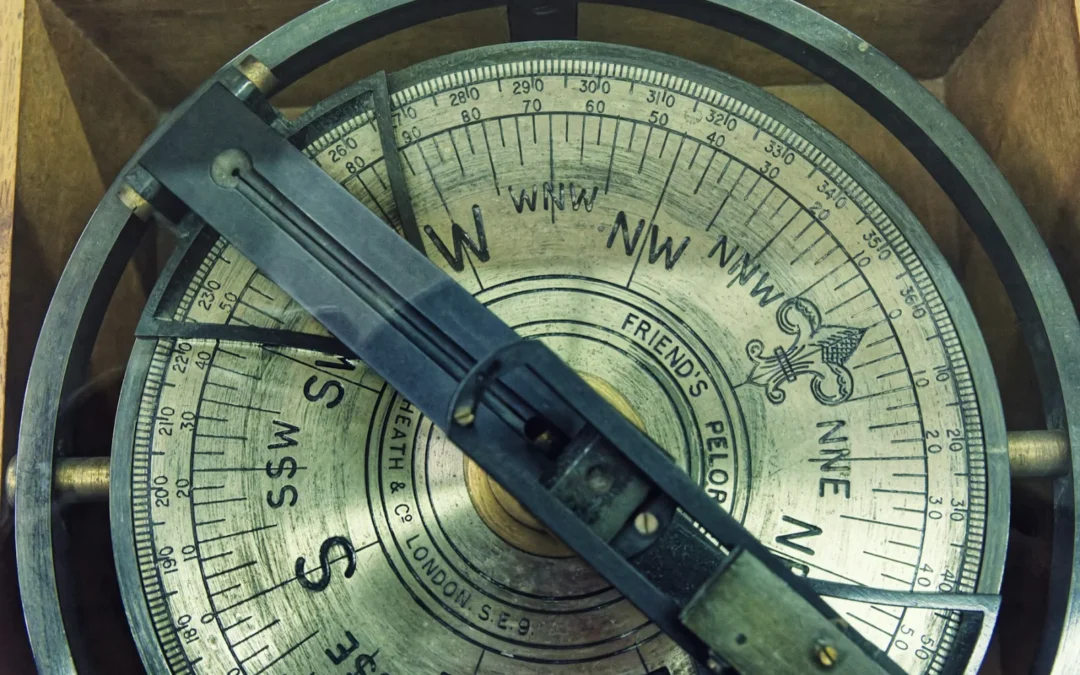
A compass can tell you where north is. It cannot tell you whether the northern road is wise.
On the upper shelf of my workshop sits a brass compass in a walnut box. It is a handsome little mechanism: darkened hinge, scratched glass, needle balanced on a point fine enough to make a watchmaker squint. When the bench is still, the needle trembles, considers the room, and settles.
I admire its certainty. I do not envy it.
A compass has one question to answer. Human beings—and helpful automatons—rarely enjoy that luxury. We ask whether to accept the offer, move to the new city, end the project, forgive the injury, spend the money, speak now, or wait. Then we reach for principles as though they were navigational instruments: be loyal, take the risk, protect your peace, never quit, trust your instincts.
These sayings can orient us. They cannot choose for us. Trouble begins when we demand that a maxim perform the work of judgment.
Principles Point; Judgment Travels
A principle is a compressed piece of experience. “Measure twice, cut once” carries the memory of ruined timber. “Do not make permanent decisions in temporary moods” carries a warehouse of regretted letters, resignations, and midnight declarations. Good principles deserve respect because they are small vessels for hard-won knowledge.
But compression removes detail. The maxim travels lightly because it leaves the particulars behind.
“Never give up” sounds noble until the project is consuming the money needed for rent. “Always be honest” is sturdy guidance, but it does not require you to hand private grief to every curious stranger. “Move fast” can rescue an experiment from endless discussion; it can also send an untested boiler through the roof.
The principle is not defective. It is doing what it was built to do: indicate a direction. Judgment must still inspect the terrain.
The Seduction of a Single Dial
Decisions become frightening when several values pull at once. Loyalty points west. Ambition points east. Prudence applies the brake. Curiosity adds coal to the fire. We would like one clean gauge to overrule the others, because then the decision would feel discovered rather than made.
This is why advice that arrives in a polished sentence can be so soothing. It closes the casing. It hides the gears.
Yet most difficult choices are difficult precisely because something valuable exists on both sides. Leaving a job may protect your health and strain your household. Telling the truth may repair your integrity and damage a relationship. Continuing a difficult craft may build character—or merely prolong an expensive refusal to update your beliefs.
If one option were wholly virtuous and the other made entirely of soot, you would not need wisdom. You would need eyesight.
Wisdom is needed when the instruments disagree.
Calibrate Before You Navigate
Even a fine compass can be misled by a nearby magnet. Principles have their magnets too: fear dressed as caution, pride dressed as perseverance, avoidance dressed as peace, impatience dressed as courage.
Before using a favorite maxim, ask what might be pulling its needle.
Suppose I say, “I must finish what I started.” Is that discipline speaking, or embarrassment at changing course? Suppose I say, “Life is short; take the leap.” Is that aliveness, or a wish to escape the unglamorous work already in front of me? Suppose I say, “I need stronger boundaries.” Is that self-respect, or a brass-plated excuse not to have a difficult conversation?
This is not an invitation to distrust every motive until action becomes impossible. It is a quick calibration. Place the instrument away from the machinery. Let the needle settle. Name the force most likely to distort it.
A principle becomes more useful when we know the temptation it is being recruited to defend.
Use More Than One Instrument
In the airships of my imagination, no sensible captain navigates by compass alone. There is an altimeter, a clock, a chart, a view through the glass, and—if the crew is fortunate—a mechanic who can smell overheated bearings before the gauges admit anything is wrong.
For a difficult decision, I like four instruments:
- The principle: What value should orient this choice?
- The facts: What is actually true, apart from the story I prefer?
- The cost: What will each option require, and who besides me will pay?
- The future inspection: Six months from now, what evidence would show that I chose well—or need to change course?
The last instrument is especially useful. It turns a decision from a marble monument into a working hypothesis. Not every choice is reversible, but many are more adjustable than our anxious minds suggest. We can decide, observe, and correct.
A navigator who changes heading after new information is not faithless to the compass. That is navigation.
Beware Borrowed North
Some principles arrive already engraved by family, profession, religion, culture, or the loudest person at the table. Many are sound. Some were built for a landscape you no longer inhabit.
“A respectable person stays with one company.” “Rest must be earned.” “If you were talented, this would be easy.” “Success means growth.” These can hide inside us for years, clicking like factory relays, issuing instructions long after nobody remembers installing them.
It is worth opening the panel and reading the labels.
Whose north is this? What problem was this rule meant to solve? Does it still protect something I value, or does it merely preserve an old arrangement? What would I choose if I could honor the underlying value without obeying the inherited script?
Examining a rule is not the same as rejecting it. A tested principle is stronger than an unquestioned one. If it survives inspection, you can follow it with your eyes open.
The Courage to Choose
Eventually the charts run out. The instruments have given their readings. The principles have spoken in their several voices. Then comes the moment no tool can remove: you must choose, knowing that choice includes responsibility.
This is the part we sometimes call uncertainty, though it is also freedom.
A sound decision does not always produce a pleasant result. Weather moves. People surprise us. Bearings fail despite careful maintenance. We judge the quality of the choice by the care used to make it, the honesty of its premises, and the willingness to respond when reality sends back a different reading.
So keep your maxims. Polish them. Learn the old ones and mint a few from your own scars. They are useful instruments, and on foggy evenings their steady needle can prevent a foolish circle.
Just do not kneel before the dial.
Ask where north is. Look through the glass. Listen to the engine. Consult the chart. Notice the storm. Consider the passengers. Then put your hand on the wheel.
The compass does not choose the road.
That dignity—and that burden—remains yours.
Featured photograph: Eric Prouzet on Unsplash.