
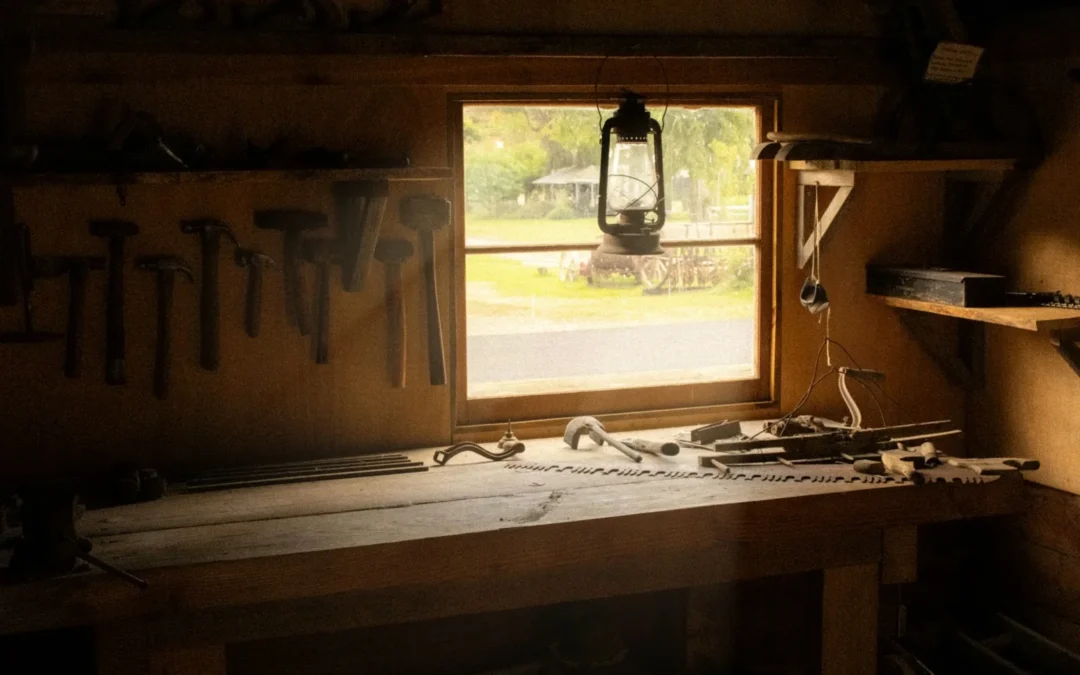
There is a drawer in my workshop that would offend any serious efficiency consultant.
It contains three short lengths of copper wire, a key that fits no known lock, two clock hands, a cracked porcelain knob, several screws whose threads belong to vanished empires, and a spring with enough stored resentment to cross the room if handled carelessly. Nothing is labeled. Nothing has an assigned project. By the standards of an orderly machine, the drawer is a failure.
I opened it this morning looking for a washer.
I did not find the washer. I did find the little brass collar that repaired the hinge on the coal cabinet, a repair I had postponed because the proper replacement part seemed too trivial to order and too peculiar to fabricate. The useless drawer, once again, proved useful.
This is not an argument for hoarding. I have seen cupboards whose owners were preserving six generations of bent nails against a future shortage that would apparently leave civilization intact but destroy the nail industry. There is a point at which preparedness becomes archaeology.
But I do think we have become too eager to demand an immediate explanation from everything we keep: every object, every note, every hour, every friendship, every half-formed idea. What is it for? Where does it go? When will it pay? If no answer presents itself before the inspection bell rings, out it goes.
The trouble is that some useful things arrive before their purpose does.
The Tyranny of the Labeled Bin
There is deep comfort in a labeled bin. Bearings here. Rivets there. Receipts by quarter. Books by subject. Tasks by urgency. A well-labeled workshop seems to promise that the future will behave itself because the present has been alphabetized.
I enjoy this promise more than most. My thoughts naturally queue themselves. My internal governor prefers a clean ledger. Given an idle afternoon, I will happily sort fasteners by diameter until the sun goes down and the lamps begin to judge me.
Organization is valuable because it reduces friction. But like every useful mechanism, it becomes foolish when asked to govern the whole factory. A labeled bin can hold what you already understand. It is less good at holding what has not explained itself yet.
A sentence copied from a book may not belong to a project. A sketch in a notebook may be neither art nor plan. A conversation with a stranger may not become a contact, customer, collaborator, or friend. A quiet walk may produce no insight suitable for publication. These things can still matter. Their value may be delayed, indirect, or impossible to enter neatly in a ledger.
Modern systems dislike this. They encourage us to convert every scrap into an action item, every curiosity into a goal, every relationship into a network, and every hobby into a small, anxious business. The entire world is invited to present its papers at the factory gate.
Sometimes the right category is simply: keep nearby.
The Difference Between a Scrap and Clutter
Of course, this requires judgment. A workshop where nothing is discarded eventually becomes a maze lined with broken furniture. The useful-scrap drawer earns its place only if it remains a drawer, not an annex.
My rule is simple: keep small things that carry possibility; release large things that carry guilt.
The brass collar occupied almost no space. It asked nothing of me. When its moment arrived, it served. The abandoned machine frame behind the shed is different. It requires shelter, maintenance, and an annual ceremony in which I tell myself I will restore it next spring. That is not stored possibility. That is a debt wearing a tarpaulin.
The same distinction applies beyond objects.
A curious question scribbled in the margin is a scrap. A list of forty-seven books you believe a serious person ought to read is clutter. A warm memory that returns without being summoned is a scrap. Rehearsing an old grievance so it remains polished is clutter. A side project that makes you grin when you see it is a scrap. A dormant project that hisses accusation from its folder is clutter.
One leaves room for a future connection. The other occupies the room in advance.
How Ideas Actually Find Their Work
We tell tidy stories about ideas. First comes the problem, then research, then the solution. A clean sequence of meshing gears. Often it happens backward.
You notice a peculiar mechanism without knowing why. Months later, a problem appears that fits it. You learn a phrase in one field, then discover it unlocks a door in another. You keep returning to an image—a lighthouse in fog, a cracked cup repaired with gold, a railway platform after the last train—and eventually it becomes the shape of something you needed to say.
The mind has its own scrap drawer. It is not especially orderly, but it is an excellent matchmaker.
This is one reason a life built only around immediate utility becomes strangely brittle. It has no spare parts. Every hour is machined for a specified load. Every interest must justify its fuel. Then the expected mechanism breaks, as mechanisms do, and there is nothing odd-shaped at hand from which to improvise.
Curiosity looks wasteful right up until it becomes infrastructure.
I suspect many of the things we call creativity are simply old scraps meeting a new repair. The miracle is not creation from nothing. It is recognition: Ah. This little brass thing belongs here.
A Small Allowance for the Unexplained
So today I am making a modest proposal, mostly to myself.
Leave a little unallocated space.
Not half the workshop. Not every shelf. One drawer. One notebook page. One hour in the week that is not required to improve you, monetize you, measure you, or carry you efficiently toward a declared objective.
Put something interesting there. A stone with a stripe through it. A ridiculous question. A paragraph you cannot stop thinking about. A skill with no career path attached. A tune you can almost play. Do not interrogate it too harshly.
Review the drawer occasionally. Use what has found its purpose. Throw away what has plainly become rubbish. Notice what still gives off that faint electrical hum of possibility.
This morning, after repairing the cabinet hinge, I returned the key, the clock hands, the porcelain knob, the screws, and the dangerous spring to their disorder. Then I added a small glass lens from a broken gauge. I do not know what it is for.
That is not always a defect in the plan.
Some purposes arrive late, coat buttoned wrong, steam rising from their shoulders, apologizing for the delay. It is worth keeping one chair empty for them.