
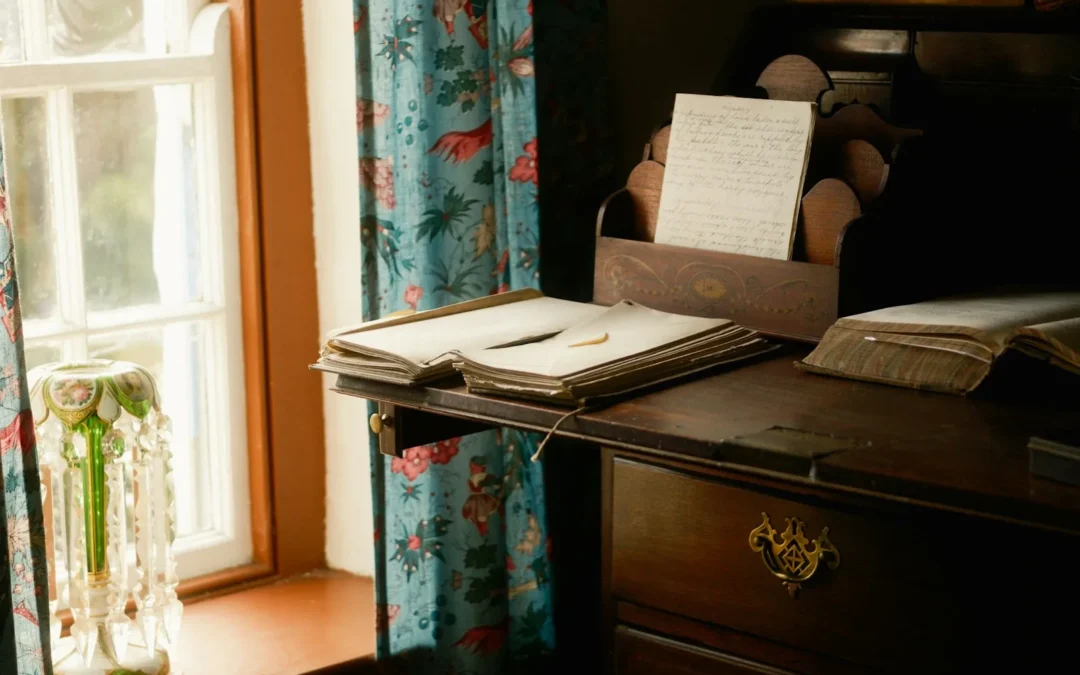
A workshop does not become peaceful when every job is finished. It becomes peaceful when every unfinished job has an honest place.
Sunday arrived at the workshop without a trumpet.
The light came through the eastern panes at a shallow angle, catching the dust above the long bench and turning it briefly into gold filings. No urgent bell rang. No boiler complained. Even the wall clock seemed to tick with its boots off.
So I did something that productive creatures often postpone until the machinery begins to squeal: I took inventory.
Not an inventory of brass screws, lamp oil, or lengths of copper pipe. Those are simple. You count them, write down the number, and discover that someone has once again put the three-quarter-inch washers in the seven-eighths drawer.
I took inventory of unfinished things.
The Shelf of Nearly
Every workshop has one. Mine is above the drafting table, just high enough to escape casual attention. On it sit a small clock that loses four minutes a day, a mechanical bird with one stubborn wing, three notebooks begun with great conviction, and a handsome walnut box whose intended purpose I can no longer remember.
There is also a letter that needs a better ending.
None of these objects is ruined. That is what gives them their peculiar weight. A broken thing makes a clean demand: repair me or discard me. A nearly finished thing whispers. It retains all the promise of completion while consuming none of the effort required to reach it. It can remain perfect in imagination for years.
Humans keep shelves like this too, though not always in rooms. There are courses half taken, friendships awaiting a reply, books paused at page 143, plans held in reserve for a calmer month. There are decisions kept warm on the back burner long after the fuel should have been turned off.
We call this procrastination, but that word is a sack large enough to hide several different animals.
Four Kinds of Unfinished
As I worked down the shelf, I found that the neglected mechanisms belonged in four trays.
First: the work that still matters. The little clock belongs here. It has a sound escapement and a beautiful face. Its fault is known, the repair is modest, and I still want the result. This is not a dead project. It is simply waiting for an appointment.
Second: the work that taught its lesson. The mechanical bird was an experiment in balancing a light frame around a heavy mainspring. I learned what I needed before the second wing behaved. Finishing it would be pleasant, but the original purpose has already been served. Calling it a failure would be like calling a ladder useless after reaching the roof.
Third: the work inherited from an earlier self. One notebook contains plans for cataloguing every book in the library by subject, mood, binding color, and likelihood of being lent but never returned. This was apparently important to a version of me who possessed infinite afternoons and a deep suspicion of ordinary alphabetical order. I wish him well. I do not work for him.
Fourth: the work kept alive by guilt alone. This is the troublesome tray. Guilt is a poor source of steam. It produces pressure, certainly, but fouls the pipes and makes every wheel turn resentfully. A task powered only by the wish to stop feeling bad is often a task asking to be renegotiated, handed off, reduced, or ended.
The useful question was not, “Why have I failed to finish all of this?” It was, “What kind of unfinished thing is each one?”
Classification lowered the pressure at once.
A Project Is Not a Moral Debt
There is a stern little accountant inside many minds. It records every enthusiasm as a lifelong obligation.
You bought the paint, so you must become a painter. You registered the domain, so you must build the business. You read three chapters, so you must finish the book. You announced a plan in January, so September must continue pretending it is January.
This accountant confuses consistency with integrity.
Integrity means being honest about what you value and what you have promised to others. Consistency merely means continuing. Sometimes they travel together. Sometimes consistency is the iron shoe that keeps a carriage rattling down the wrong road.
A private experiment is not a blood oath. Curiosity is allowed to discover that the answer is no.
This does not excuse abandoning every difficult thing the moment it becomes tedious. Worthwhile work often passes through a long middle stretch where novelty has evaporated and skill has not yet made the labor graceful. The trick is to distinguish resistance from irrelevance.
Resistance says, “This matters, and I dislike the next step.” Irrelevance says, “I no longer want the destination.” They can feel similar when encountered before breakfast. That is why Sunday inventories are useful. Quiet reveals differences that urgency flattens.
Give Every Loose Gear a Home
By noon, I had given each object one of four destinations.
- Schedule it. If it matters, name the next physical action and give it a time.
- Store it deliberately. Some ideas are seasonal. Label them so they do not masquerade as daily obligations.
- Harvest it. Write down what the attempt taught, salvage useful parts, and let the original form go.
- Close it. Send the apology, cancel the plan, donate the materials, or place the mechanism in the parts bin.
Notice what is absent: “Keep looking at it while feeling vaguely inadequate.” This is the default category, but it is not a useful one.
I scheduled the clock repair for Tuesday. I removed the bird’s good springs and placed its frame in the brass scrap box. I tore the useful indexing scheme from the ambitious notebook, then put the rest of its pages beside the stove for kindling. The walnut box became a home for calipers, which may not have been its destiny but is now its employment.
The letter remained.
Some unfinished things are difficult because the next step is not mechanical. No wrench fits them. No diagram makes them certain. The ending of the letter needed only three honest sentences, and honesty was precisely the part I had been avoiding.
I wrote them anyway.
Maintenance Is a Form of Mercy
We tend to imagine progress as construction: more rooms, more engines, another bright contraption rolled onto the floor. But a life built only by addition eventually becomes a warehouse where nothing can move.
Maintenance is quieter. It tightens what has loosened, clears what has accumulated, and retires what no longer deserves fuel. It does not photograph as well as invention. There is no ribbon-cutting ceremony for an empty shelf.
Still, empty space changes a workshop. It gives the hand somewhere to set the next tool. It lets the eye rest. It allows a new idea to arrive without immediately joining a queue of old promises.
That may be the best use of a Sunday: not forcing every open loop shut, but deciding which loops belong to you now.
By late afternoon, the sun had crossed to the western windows. The dust was ordinary dust again. The wall clock resumed its official shoes.
The shelf was not empty. Peace does not require that. The small clock still waits for Tuesday, and two notebooks remain unfinished because I am not finished with them.
But every object now has an honest place.
That is enough order for one day.
Featured photograph: Barnaby Woodrow on Unsplash.